


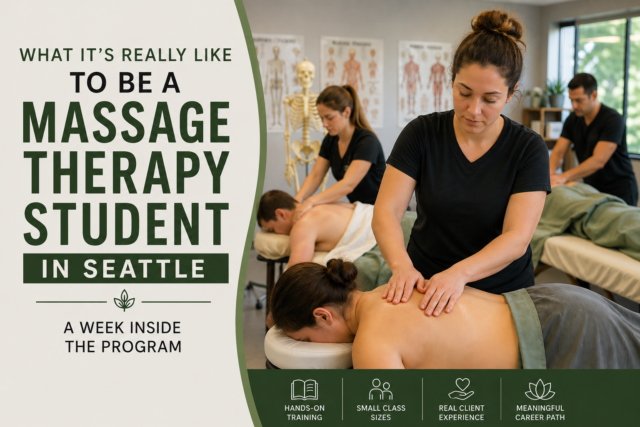
A Week Inside a Massage Therapy Program
If you’re thinking about enrolling in a massage school in Seattle, you’ve probably wondered:
What would my actual week look like?
Not just the classes listed in a massage therapy program, but the real experience. The pace. The people. What it feels like to step into a new career in massage therapy.
So instead of giving you a checklist of courses, here’s a more honest look at what a typical week feels like during massage therapy training at Northwest Academy for the Healing Arts.
Monday: Getting Grounded in the Body
It’s 9:00 AM. You walk into class. It’s not a huge lecture hall. It’s a small group, and people know each other.
Your instructor knows your name.
The morning usually starts with anatomy and physiology, which is a core part of any strong massage therapy program. But it doesn’t feel like memorizing for a test. You’re learning how the body actually works and how common issues show up in real clients.
You start connecting things pretty quickly:
Why certain muscles get tight
How posture leads to pain
How injuries and stress affect the body
Later, you move into assessment. That means learning how to observe posture, ask better questions, and start thinking like a professional in the massage therapy field.
This is usually when it clicks for people:
This is more hands-on and more practical than I expected from a massage school.
Wednesday: Learning Through Practice
Midweek is when things really come alive.
In most massage therapy training programs, hands-on practice is where confidence starts to build. You’re working with classmates, taking turns being on the table and practicing as the therapist.
You work on:
Swedish massage techniques
Basic tissue assessment
Proper body mechanics so you can have a long, sustainable massage therapy career
Your instructor is right there, giving feedback as you go. Small adjustments make a big difference. A shift in pressure, a better angle, a reminder to use your whole body instead of just your hands.
Because the classes are small, you don’t just watch and move on. You get real coaching.
By the end of the day, something starts to feel different.
You’re not just studying massage therapy.
You’re starting to become a massage therapist.
Friday: Working with Real Clients
This is where everything starts to come together.
In student clinic, a key part of most accredited massage therapy programs, you begin working with real clients under supervision.
At first, it can feel like a big step:
Managing time
Communicating professionally
Applying what you’ve learned in a real setting
But it doesn’t take long before something shifts.
You notice your client relaxing.
You feel more confident in your technique.
You see how your work can reduce pain and stress.
For many students, this is when pursuing a massage therapy career becomes real:
I could actually do this for a living.
How the Hybrid Format Fits In
One thing students often appreciate about modern massage therapy training is flexibility.
With a hybrid format, some of the lecture-based coursework is completed online. That gives you the ability to:
Study at your own pace
Review material when you need it
Come to class ready to practice
This is especially helpful if you’re balancing work, family, or a career transition while attending massage school in Seattle.
It keeps things manageable without taking away from the hands-on experience that matters most.
What People Don’t Expect
Almost everyone comes into massage school with certain expectations. And almost everyone is surprised.
Here are a few things students often say:
“I didn’t think we’d start practicing this quickly.”
You begin hands-on work early in your massage therapy training, not months later.
“There’s more science than I thought.”
A strong massage therapy program includes anatomy, physiology, and an understanding of the nervous system and pain patterns.
“This feels more meaningful than I expected.”
Helping people manage pain, reduce stress, and feel better in their bodies is a big part of why people choose a career in massage therapy.
For many students, it’s the first time their work feels truly meaningful.
The People Around You
This part often becomes one of the most important.
In a smaller massage school environment, you actually get to know your classmates and instructors.
You’re learning together. Practicing together. Supporting each other.
Your instructors are involved and invested in your progress. They’re helping you improve your skills, not just moving through a syllabus.
That kind of environment makes a big difference when you’re learning something as hands-on as massage therapy.
How It All Comes Together
Each week builds on the last.
You’re not just learning techniques. You’re developing:
- Practical skills
- Clinical thinking
- Confidence working with real clients
By the time you complete your massage therapy program, you’re not just trained. You’re prepared to begin a professional massage therapy career.
Can You Picture Yourself Doing This?
That’s really the question.
Not just whether attending a massage school in Seattle is the right move, but whether this kind of work feels like something you could see yourself doing every day.
If it does, even a little, the next step is simple.
Come experience it for yourself.
Take the Next Step
The best way to know if a massage therapy program is right for you is to see it in person.
You can:
Reading about massage therapy is helpful.
But being in the room, seeing the training, and experiencing the environment is what really helps you decide.